Showing posts with label equations. Show all posts

Saturday, May 12, 2012

Graphing Calculators and Problem Solving


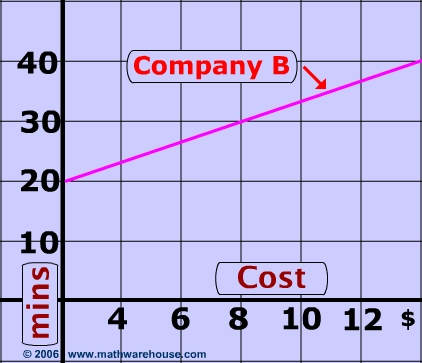
A highlight of student work this week was using the Slope-Intercept make equations, find patterns in data, and create scatter plot graphs.  It was also neat to see how students began to think of solving a system of equations using graphs of the equations:
y=.49x +10
y=.99x
Students found that the graphing calculator tool, meta-calculator.com, produced quick and accurate results. 

The solution to the 2 equations above is the point where the lines intersect.  This point is at approximately (20,20).   So, how does this graph help answer last week's Music Download word problem? 
Our definition for the variables... x= the number of songs, and the variable y= the cost of the songs.
We discovered that ...When 20 songs are purchased the price of the 2 plans happens to be the same. (around $20).
Therefore...When more than 20 songs are purchased the first plan is a better deal, when less than 20 songs are purchased the 2nd plan is cheaper.

Use the graphing calculator application to solve this problem: What solution do you find for the system of equations?
 y= -3x+2
 y= 2x-3
How would you check to make sure this solution is correct?
Find more interactive practice problems with answers at http://regentsprep.org/REgents/math/ALGEBRA/AE3/PracGr.htm

Friday, May 4, 2012

Slope Fits into Equations

How do we solve problems that involve changing costs, or other things that are in flux in our world?  In Math equations are used to figure out all the possible scenarios that may occur.  The equation y=mx+b shows a linear pattern that can be drawn on a graph or put into a table. 
This week in Middle School we wanted to purchase several items that cost the same amount.  The cost of each item was then multiplied by the # of items that we wanted to buy.  This cost is called the slope, or the rate of each item.  If we had a delivery fee, or other fixed cost that was included we had to add this to the equation too.  When making a decision it is helpful to use the slope-intercept equation to explore the cost.

Here's a problem to get started thinking about how slope fits into real life problem solving...
Musicmatch, an online music store, charges a $10 dollar membership fee plus $.50 cents per song. i Tunes sells songs for $.99 cents each, but doesn't
charge a membership fee. 
Which company offers a better deal for the music lover?
Set up an equation in slope intercept form
that can be used to find the cost for any number of songs.
 
The following website offers consumer reviews of different online music companies that may be an even better deal. Check them out at Music Download Reviews.

First we begin by comparing each music plan.  In looking at the problem, What things could change as a person begins using each plan?  We should be able to find two variables that can be represented by x and y in the problem.

After we have found the variables we look at the cost of each song.   This unit cost, or slope is represented by the letter m in the slope-intercept equation. (y= mx+b)  Slope is also called the unit cost, or rate of change.  When setting up the equation we use slope to show the rate of increase or decrease.  Slope is also how fast the rate increases or decreases.  An interesting observation that students made while graphing lines on a coordinate plane was the steeper the line the greater the number of the slope.  Can you identify what the slope is for the different music plans?
If not, or for more about the slope click on this hyperlink--- The slope.

The Y-Intercept on a graph shows where the line crosses the y-axis.  In problem solving this can be also expressed as a fixed cost or starting point for how much a person would pay up front.  For example, if a club has a membership fee that must be paid in addition to buying songs. For example, if i tunes had charged a $5.00 membership fee this would be added on to the equation.  y=.99x + 5  Can you tell what the y-intercept for Musicmatch would be?  Does i Tunes have a Y-intercept, why or why not?

The slope and y-intercept are written in Slope Intercept Form. (y=mx+b)  As we try different values and put them in for the x=#of songs, or y=total cost, we can further explore the advantages of each music plan.
Which plan did you find to be the better deal for the music lover?  What other strategies can use to solve this problem?

I found it interesting to explore music plans that are available online.  It would be great to hear about other plans that are advantageous, or other links that would give data to support this inquiry.

Thursday, February 2, 2012

Popcorn Friday's: 8th Grade Fundraising

Eighth grade graduation fundraising has involved the business minded skills of the students selling taffy apples, buttons, and popcorn.   The sales will off set some of the costs for eighth grade graduation activities.  Students show teamwork by working together towards their goal of reducing graduation costs.  Friday popcorn sales involve the students measuring ingredients, collecting money, keeping records of sales, and problem solving for optimal sales each week.

What are some ways that math is used as students help manage a fundraiser?  Problems and questions often surface when we are popping away, or looking back at the figures.  For example, this week sales of popcorn were a total of $146 dollars combined between the early morning and afternoon shifts.  The first shift sold ten dollars more than the second shift.  How much money did each of the shifts make during their sales? 

The overall sales of shift 1 (x) and shift (2) y, equalled 146 dollars.   The equation is expressed as x+y=146
Another part of this problem involves the money earned by the second shift. y= x+10.
Solving a pair of equations can be done by solving for x algebraically, using guess and check, or a host of other strategies.  The equation way will substitute the second equation into the first equation.  Namely, x+(x+10)=146.   2x=136, x=68.   Then if x=68, y+68=146.  So y=$78.  Check involves 78+68= 146. 

The math involved in figuring out this equation likely relates to other situations or questions that have come up in managing events like a fundraising.  It'd be great to hear from you.  Share some ways that you have seen math being used.

Sunday, November 13, 2011

Equations and Surface Area of a Figure

Equations are a way we represent a problem by using numbers and symbols.  After we develop an equation it becomes easy to apply it to many similar problems. 
Pythagoras, a famous mathematician developed a famous equation to find the side lengths of any right triangle.  His equation is called the Pythagorean Theorem. A theorem is a math rule that is developed from tests over time.  It is kind of like a science experiment in that it has to be proven through repeated tests. 
The equation shows that the square of the sides of right triangles forms a pattern.  It says that a right triangle has a side across from the right angle which is equal to the sum of the other two sides squared.  In equation form:  a^2 + b^2 = c^2  This equation is shown in picture form at this web link- Pythagorean theorem
We can use the Pythagorean theorem to solve real life problems that involve finding the sides of triangles.  I think it's interesting how the web link above has problems about finding the distance on a baseball diamond, and finding the length of a ladder needed to reach a window.  Careers in medicine, construction, engineering, and architecture use equations to solve problems.
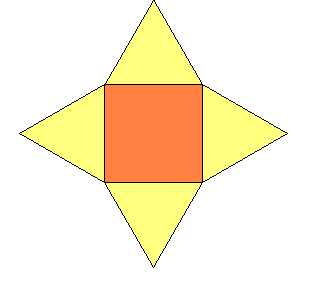
One example is how 3D figures like square pyramids use the Pythagorean theorem. For example, how do I find the surface area of a square pyramid?  Surface area is found when we want to know the amount of material needed to cover a 3D shape.
A square pyramid has four triangles and one square as shown in the net of the 3D shape above. The 3D shape becomes folded out in a "net" or "net drawing". The website Interactives 3-D Shapes shows a video clip of how to make a net.
The Pythagorean theorem can help us find the side lengths of the triangles if we know the side lengths but need to find the height.  The base of a yellow triangle needs to be bisected, or divided in half with a perpendicular line, to form a right angle.  If the base is 6 cm and we bisect it, then the side of the right triangle formed will be 3 cm.  If the hypotenuse, or side across from the right angle is 5 cm then we can find the height with the Pythagorean theorem.
We use the equation 3^2 + b^2 = 5^2 to find the height of the triangle.  When the equation is used to solve for the missing side we can find the exact length quickly!
Can you find the missing side using the equation above?  Which city buildings or designs use the square pyramid shape?