Tuesday, February 28, 2012

How Tall is That? Using Similar Triangles

The figure above shows a problem of: How tall is the flagpole?  Our 8th grade Math investigation showed a way to find out the height of a cliff using similar triangles like the ones pictured above.  It is important to remember that similar figures share corresponding sides and corresponding angles.  Corresponding angles have equal measures, while corresponding sides have the same ratio.  In the picture above, the corresponding sides on the base of the similar triangles show a ratio of 15.5/4 which equals 3.875

Several eighth graders discovered a strategy to figure out the missing side by using the ratio multiplied by the corresponding side.  For example if we wanted to find the height of the flag pole, this strategy says we take 3.875 times 3, which gives the height of 11.625.  

If you want to find out more about how to use this method to find the height of familiar objects, such as skyscrapers, trees, or towers check out the website Connecting Geometry   
Another fun pair of links to sharpen your math skills are Math Videos at Khan Academy.  Check out the video links below and more great videos on Khan Academy.

Sunday, February 19, 2012

Interactive Integer Flash Cards and Slope Practice

Try your skill at integer operations.  Solve the integer operations flash cards.  Check your answer by clicking the card after you solve the problem.  Then move the flash card to the correct or incorrect pile.  Try again and see how many you can get correct. 
Afterwards, add a comment below and some strategies you like to use for solving integer operations. 


More flashcards and educational activitites at StudyStack.com

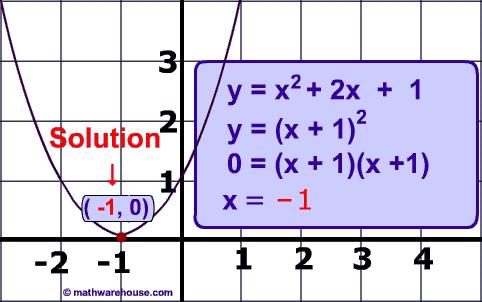
Click on the Link Below to practice finding the slope of a line
Interactive slope of a line from Mathwarehouse.com

Thursday, February 2, 2012

Popcorn Friday's: 8th Grade Fundraising

Eighth grade graduation fundraising has involved the business minded skills of the students selling taffy apples, buttons, and popcorn.   The sales will off set some of the costs for eighth grade graduation activities.  Students show teamwork by working together towards their goal of reducing graduation costs.  Friday popcorn sales involve the students measuring ingredients, collecting money, keeping records of sales, and problem solving for optimal sales each week.

What are some ways that math is used as students help manage a fundraiser?  Problems and questions often surface when we are popping away, or looking back at the figures.  For example, this week sales of popcorn were a total of $146 dollars combined between the early morning and afternoon shifts.  The first shift sold ten dollars more than the second shift.  How much money did each of the shifts make during their sales? 

The overall sales of shift 1 (x) and shift (2) y, equalled 146 dollars.   The equation is expressed as x+y=146
Another part of this problem involves the money earned by the second shift. y= x+10.
Solving a pair of equations can be done by solving for x algebraically, using guess and check, or a host of other strategies.  The equation way will substitute the second equation into the first equation.  Namely, x+(x+10)=146.   2x=136, x=68.   Then if x=68, y+68=146.  So y=$78.  Check involves 78+68= 146. 

The math involved in figuring out this equation likely relates to other situations or questions that have come up in managing events like a fundraising.  It'd be great to hear from you.  Share some ways that you have seen math being used.

Sunday, January 29, 2012

Contest Winners and Graphing Links

Congratulations to all the participants of the Sumdog.com Winter Challenge! 
The top 10 winners were...
10  Devon
9  Alvaro
8  Elma
7  Medina
6  Victor
5  Edin
4  Priscila
The top 3 winners were...
3  Neerida
2  Luis
1 Amir

Here are some math links to check out, enjoy!
Compare quadratic function graphs: -5x^2 + -5x + 5
How do I simplify an expression like 3x + 2 + 4x - 2y - 1?
Free Graphing Calculator

Wednesday, January 11, 2012

Advertisements and Percents of Change

Is this the best deal?  What discounts are being offered?   The advertisements online and in print are full of discounts that can be beneficial to savy shoppers.  
For example, Target's website shows discounted prices on movies.   http://www.target.com/sb/entertainment-movies/-/N-5xsx0Z5zktyZ5zja2.  One movie that is adverstised is Harry Potter and the Deathly Hallows.  The original price is shown as $28.98, and the sale price is $12.99.  This can be estimated to be a 3/5 or 60% decrease in price.  The prices listed on the webpage make it is easy to find the percent decrease.  What other percent decreases are there on DVD's at Target?  Is there a better deal (more than 60% off DVD's at Target?  One way to find out is to compare the percent change.
If you'd like to learn more about percent change and spend some time playing a computer game, here's a weblink from The Percent Shopping Game.
http://www.mathplayground.com/percent_shopping.html

Saturday, December 31, 2011

The Power of Patterns


Art ignites the imagination, and one of the fascinating aspects of art is the use of patterns.
Pascal's Triangle shows many patterns that are useful in mathematics.  The third diagonal from the left shows the triangular numbers (3, 6, 10, 15...)  These numbers show the number of dots that are needed in order to create a triangular shape.
Another pattern that can be seen with triangular numbers is when adding the counting numbers together.
(1+2= 3,  1+2+3= 6,   1+2+3+4= 10, and 1+2+3+4+5=15,...) 
When adding together a the numbers 1-10 in the same way a pattern can be found.
For example the sum of the numbers 1-10 is the tenth triangular number on the pyramid above. What patterns do you notice in the numbers leading up to the triangular number 10? 
Here's a hint:  if you take the 2nd triangular number 6, and compare it to the ones in front of it and behind it, what do you notice?
Another clue is if you list the addends and add the first and last numbers, what do you notice?
Mathematicians notice patterns and experiment with writing equations to show a general rule.  These patterns can create pyramid's of numbers that continue to grow.  

Friday, December 23, 2011

Happy Holidays!

The Swift School International Assembly began our week before Christmas holiday cheer.  Congratulations to all the performers who shined on stage.  The folk tale renditions from different regions of the world introduced each of the talented groups.  The mix of visual arts with cultural clothing and decorations brought a lively environment for all of us to enjoy.  Swift School musical talents included performing on musical instruments, singing, and dancing.  This celebration of culture showed our pride in teamwork, artistic expression, and diverse backgrounds.

Holiday crafts are a relaxing way to enjoy the season.   Create your own unique snowflake on this website and then share it along with a holiday greeting for a friend.   You can find this at Snowdays

Sunday, December 4, 2011

Congratulations to the Math Contest Participants!

Congratulations go out to all the Swift Middle School students who participated in the Sumdog.com Math Contest.  The contestants earned a combined total of approximately 38,671 points!  Top classroom contestants for the math competition include:
312:  Neerida
         Devon
313:  Linda
         Amari
314:  Ayana
         Elma
315:  Jennifer B.
         Sandra
The overall winners for the contest earned a combined total of 26,484 points! 
1st place-  Linda,   2nd place- Neerida,  3rd place- Amari
Congratulations to all the 7th and 8th graders who have played the Math games.  Games are a great way to relax and have fun doing the math.  Illinois is having a state wide Sumdog.com contest coming up soon, and there will be many other chances to use math games this year.  

Tuesday, November 29, 2011

Math Contest: Fall 2011

This week we've started an online challenge for Swift Middle School.  8th grade students select games to play from the website, Sumdog.com and earn points for each time they score.  The games not only involve gaming ability, but have some problem solving and math knowledge as well. 
Students can play as much as they like and earn extra credit homework points for their scores or comments on our class blog.  
Please comment below to share some of your favorite games, and tips for this math challenge. 

Friday, November 18, 2011

Stretch your skills at fractions and probability

Check out the online versions of Connect Four and Racing Game!  Click a link below to begin.
Connect Four 
Racing Game

Below are 3 easy steps for finding the sum or difference of fractions include:
1) Find a common denominator-  list the multiples of both denominators and find the lowest one in common. 
example  2/5  +  1/2     5 and 2 both have  a common multiple of 10
2) Make equivalent fractions- Divide the original denominators by 10 (common denominator).  Use the quotient to multiply by the numerator. 
example  10/5=2   2(2)=4  equivalent fraction 2/5 = 4/10;   10/2=5  5(1)=5  equivalent fraction 5/10=1/2
3) Add/Subtract numerators- Keep the denominator the same, and take the sum or difference of the numerator
example   4/10 + 5/10 =     4 + 5    =  9
                                          ------      ---
                                            10         10

Real life use of Fractions involves beats in music, cooking recipes, clothing design, city buildings, and sports statistics.  What are some ways you see fractions used in real life?  How does your science fair experiment involve the use of fractions, data, or math displays?       

Sunday, November 13, 2011

Equations and Surface Area of a Figure

Equations are a way we represent a problem by using numbers and symbols.  After we develop an equation it becomes easy to apply it to many similar problems. 
Pythagoras, a famous mathematician developed a famous equation to find the side lengths of any right triangle.  His equation is called the Pythagorean Theorem. A theorem is a math rule that is developed from tests over time.  It is kind of like a science experiment in that it has to be proven through repeated tests. 
The equation shows that the square of the sides of right triangles forms a pattern.  It says that a right triangle has a side across from the right angle which is equal to the sum of the other two sides squared.  In equation form:  a^2 + b^2 = c^2  This equation is shown in picture form at this web link- Pythagorean theorem
We can use the Pythagorean theorem to solve real life problems that involve finding the sides of triangles.  I think it's interesting how the web link above has problems about finding the distance on a baseball diamond, and finding the length of a ladder needed to reach a window.  Careers in medicine, construction, engineering, and architecture use equations to solve problems.
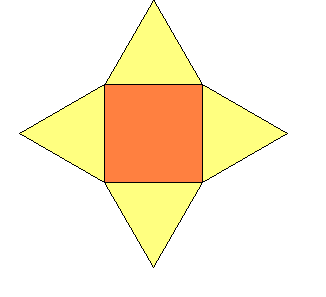
One example is how 3D figures like square pyramids use the Pythagorean theorem. For example, how do I find the surface area of a square pyramid?  Surface area is found when we want to know the amount of material needed to cover a 3D shape.
A square pyramid has four triangles and one square as shown in the net of the 3D shape above. The 3D shape becomes folded out in a "net" or "net drawing". The website Interactives 3-D Shapes shows a video clip of how to make a net.
The Pythagorean theorem can help us find the side lengths of the triangles if we know the side lengths but need to find the height.  The base of a yellow triangle needs to be bisected, or divided in half with a perpendicular line, to form a right angle.  If the base is 6 cm and we bisect it, then the side of the right triangle formed will be 3 cm.  If the hypotenuse, or side across from the right angle is 5 cm then we can find the height with the Pythagorean theorem.
We use the equation 3^2 + b^2 = 5^2 to find the height of the triangle.  When the equation is used to solve for the missing side we can find the exact length quickly!
Can you find the missing side using the equation above?  Which city buildings or designs use the square pyramid shape? 

Monday, November 7, 2011

Attack Integer Computation with Success

Integers are made up of natural numbers 0, 1, 2, 3... and negative whole numbers  -1, -2, -3...
The number line is a familiar way to recall the rules of computing integers.   In the example pictured above we see the numeral two as our starting point which is symbolized with a dot.  This is followed by a subtraction sign, which leads us to move to the left three spaces as shown with curved line and arrow.
Helpful hints are another way that we can remember how to add and subtract integers.
We learned the first hint: Two like signs become a positive sign.
Example  2 - (-3) = ?   This can be rewritten as 2 + 3 = ? since there are 2 like signs in the original problem. 
Another example  -3 - (-4) = ?   Rewritten as - 3 + 4 =? Again like signs - and - turn into a positive sign.

And conversely the second hint: Two unlike signs become a negative sign.
Example 2 + (-2) = ?  This is rewritten as 2 - 2 = ? because there are unlike + and - signs in the problem. 
Another example  -4 + (-2) = ?  Rewritten as -4 - 2 ?  We start at -4 on a number line, and move to the left (away from zero) 2 spaces.  This leads us to -6 as the difference. 

Now, we find the product or quotient of two integers to be:
Positive only when both integers are positive, or both are negative.
Examples:  -4(-4) =  -4 * -4 = 16     -24/-2 =  12
Negative when one integer is positive and the other is negative.
Examples  30/(-5)= -6  or   -5(7) =  -5 * 7 = -35

Which type of integer calculation do you find easiest to solve?   
Try your skill with the interactive version of Integer Battleship found at the link below.  After you make a locate a Battleship you'll be challenged with an integer problem to see if you can hit the target.
Integer Battleship   


What are some other tips that you have for ways to calculate integers?  Share a website, strategy you've learned from a teacher, or a way that helps you keep integer computation clear.   What other games or activities have you done with Integers?  Work at it and Integer computation will become automatic.

Tuesday, October 18, 2011

Student Math Projects- Amazing Facts and Feats: Data Displays

Have you ever wondered, Is that even possible? Or, was that statement really true? Amazing facts can sound too incredible to believe.
Our projects will show some of these amazing facts and feats. Take for instance the fact that "Humans breathe about 23,000 times a day!" If you measured a person breathing for one minute you may find that they breathe about 20 times. That same person would breathe about 1200 times in an hour, and 28,800 times in a day. The Math and Data Displays behind the fact helps us to judge whether this sounds believable or not.
We will be able to find information to support the amazing facts and feats from books, computers sources, or teachers/librarians/adults that we know. For example, a website called, Interesting Facts lists some Science related facts:

• Each person sheds 40lbs of skin in his or her lifetime.
• Koalas sleep an average of 22 hours a day, two hours more than the sloth.
• Light would take .13 seconds to travel around the Earth.
• The largest desert in the world, the Sahara, is 3,500,000 square miles.

21facts.com also has some interesting facts about the Civil War that you may or may not believe?

• The total deaths in the United States Civil War was over 1,000,000 people
• During the Battle of Cold Harbor in the Civil War there were 7,000 people that died within 20 min.
• There were over 550 generals who served during the Civil War.
• A Confederate prison camp called Andersonville had 12,000 people die.

Books like the World Almanac, Atlases, as well as Encyclopedias could be used to find out more about these amazing facts. There is often a lot of background information and facts that can help to make the amazing facts more believable. On the other had the research often helps us point out errors or misconceptions. Either way our projects will have fun with the investigations.

Saturday, October 8, 2011

Extra Support from Loyola Teacher Candidates

Swift 7th and 8th graders advance their math skills with the help of Loyola's tutoring support and team teaching.
Our Loyola teacher candidates include:
8th- 313 Jessica & Elizabeth
8th- 312 Jessica
8th- 315 Hana
7th- 314 Haley & Christina
Emphasis for these lessons is on building mathematical vocabulary, developing math concepts, strengthening math fluency, and supporting math problem solving.
Loyola University has a library of math videos. Click on this link for- Countdown Videos
These videos include review of math content and support students'
development in mathematical thinking.
What are some of your favorite activities that you've done in math?
Do you find videos helpful in reviewing and learning math? Why or Why not?

Tuesday, October 4, 2011

Best Fit Lines on a Scatter Plot

Best Fit Lines show the general direction of points on a data display. The best fit line doesn't connect the points, but instead is shown to be close to as many points as possible within the constraints of a straight line.

This week students measured their heights and jumping heights using meter sticks. These two variables were compared to see if one of them had any effect on the other. For example, does the height of a person affect how high the can jump? The Scatter Plot display of our data should help us see whether the answer to this question is true, or false.

Here is a website that has information and questions about scatter plots. I like the fun graphics and the way the questions give feedback about your answer. Click here to find an interactive Scatter Plots Website

Another website called The Challenge Club shows the steps to create a scatter plot.
Besides comparing the example above about whether tall people have larger hands or not, you can make scatter plots about things you're into. For example whether your favorite band's new album sales relate with the amount of attention that they're getting on the radio or Internet.
Does one thing affect another? When we make a scatter plot and draw a best fit line, we can see the relationship more clearly.

Wednesday, September 28, 2011

Amazing facts and music

The variety of musical interests' of Swift students is shown through the graphs and charts outside Ms. Gamble's room. The data that shows what kinds of music we prefer fits in well with the circle graph and bar graph displays. Other types of music facts such as specific information about favorite albums, songs, the number of awards, or how long a song remains popular can be interesting to check out too. Some of these facts can best be shown on graphs with types of averages- box and whisker plots, changes over time- line graphs, and relationships between data- scatter plots.

One website where music data from all genres is shown is called All Music. This website gives a plethora of updated facts on musicians. The link above shows the band "Sugar Ray" from the 90's and early 2000's. In addition to some amazing numbers the website gives the bands history and links to other bands that are similar.

What links to musicians have you found on the Internet? A band's website, Face book page, or a music station like All Music that has lots of different bands?

Sunday, September 25, 2011

Data Displays

How to make your favorite data display?

Circle Graphs-

Start with a table for Categories, Frequency, Percentages, and Angle Measures.
Use a compass to draw the circle and form sectors using a protractor and the angle measures.
Label the circle graph with categories, percentages and colors for each sector.

Example- What is your favorite color?

Category- Blue; Frequency- 4


Percentage- 4/10 = 40%


Angle Measure- .40*360= 144 degrees


Interactive Website: Making a Histogram. Online resource to use- Illuminations Webpage

Find the range of your data and determine your intervals. Make a data table with Intervals and Frequency (number of data points in those intervals). Label your vertical (y-axis) with frequency and the horizontal (x-axis) with the intervals in your table. The bars on your histogram should touch each other and run continuously along the x-axis. Label your histogram with a title and label for your horizontal axis to represent the meaning of the data.

Example: Weekly Hours of Practice: Data 12, 21, 16, 18, 31, 25, 8, 22
Intervals 0-9, 10-19, 20-29, 30-39
Frequency 0-9 =1, 10-19 =3, 20-29=3, 30-39=1

The circle graph and histograms are both interesting visual graphs that show comparisons.
One key difference is the histogram can show the frequency of an event or how many times it falls within a certain interval. What other situations or data sets could you use for circle graphs or histograms? What tips can you offer to display data in a clear and entertaining way?

Friday, September 16, 2011

Quotes about Life

When we want a little inspiration, or to reflect on why we are here Quotations can help us open up a discussion or think about something more deeply. Below are some quotes that I found inspiring as we begin a new school year. What thoughts do these quotes bring to mind for you? What are some of your favorite life lessons or quotes?

"The best way to cheer yourself up is to try to cheer somebody else up" Mark Twain

I like this quote because when I am helping and encouraging others I feel uplifted. What are some things in your life make you feel joy?

"Talent is like electricity--we don't understand electricity we use it" Maya Angelou

Each person brings unique talents that they can offer to share with others. We don't understand why we have these talents but it is these things that make us special. What is a special talent or interest that you have?

"So you see! There's no end To the things you might know, Depending how far beyond Zebra you go" Dr. Seuss

We can stretch ourselves far beyond where we once thought possible. The zest in our imagination will bring us new knowledge and stretch our potential as humans on a rich planet. What are some things that you've learned or wished to learn which help you grow?

"Home is where one starts from" TS Elliot

The foundation that we've learned from our families carries with us. Who are those people in your life you call family?

"No one can make you feel inferior without your consent" Eleanor Roosevelt

We are in charge of our lives. The power to change our mood, move past misfortune, and overcome obstacles makes us stronger. What challenges have you overcome in life?

"If a person doesn't keep pace with their companions, perhaps it is because he hears a different drummer. Let him step to the music which he hears, however measured or far away" Henry David Thoreau

"Nothing can be loved or hated unless it is first understood" Leonardo da Vinci

"The injury we do and the one we suffer are not weighed in the the same scale" Aesop

"We may all have come on different ships, but we're all in the same boat now" Martin Luther King Jr.

"We must be authors of our own age" Madeline Albright

"No individual has any right to come into the world and go out of it without leaving behind him/her distinct and legitimate reasons for having passed through it" George Washington Carver

"Genius is 1 percent inspiration, 99 percent perspiration" Thomas Edison

"A book is like a garden carried in a pocket" Chinese proverb

Sunday, August 21, 2011

It's a Small World

The chance to travel to a new place can be a fun way to learn about other cultures around the world. If you're limited by time or money reading a book, website, or listening to music may be a great way to experience another place.
Here are some websites that are fun to check out when exploring life in other places.

A website that shows different parts of the world is found at A Kid's Life in...
Teens and kids who live all over the world show us about their country. I like how you can get a first hand account about different places. The web site's graphics also help you to get a sense for interesting aspects of their culture.

Another handy resource when looking at different countries is a metric/customary conversion chart which can be found at Kid's corner: Metric Weights and Measures
When have you needed to convert between metric units, or from customary to metric units? Last year, I was training for a 10K run and wanted to know how many miles I'd need to train for. The conversion, 1.6093 kilometers = 1 mile would have been useful. Before running I thought it was around 5 miles, but after checking the math I realized a had run more.

Another question that's worth asking is: How much is your money worth? Money Exchange is done on a daily trade market which can be found at XE World Currency Converter.
This converter tool has a calculator type feature that will show you exactly how much your money is worth on any one day. For example, upon checking we can see that one US dollar is worth 12.5150 Mexican pesos. Which other types of currency do you know about? What other travel resources have you used that could also be helpful?

Saturday, August 6, 2011

Sizzling Sounds of Summer

The sounds of music add sizzle to the summer. In outdoor venues the sounds of music fill the air. Some of my favorite venues in the summertime are Millenium Park and Ravinia.

Millenium Park area has an incredible Jazz Festival. One jazz musician is two time Grammy Award winner, Roy Hargrove. Hargrove plays jazz that is infused with hip hop, funk, gospel, and soul music. The Video link here shows Hargrove playing the trumpet along with lots of rhyme and soul. I like how jazz music blends different styles together. Concerts at Millennium Park are free of charge and bring lots of talented musicians to Chicago.

Ravinia is a 30 minute Metra train ride north of Chicago. Like Millenium Park, Ravinia is a summer time festival that has famous musicians and young stars. Ravinia has tunes from lots of different bands including Rock, R&B, Blues, Country, Gospel, and Classical. The Chicago Symphony Orchestra (CSO) plays at Ravinia on many nights. Trumpet player, Tage Larsen from the CSO has a video link here. Larsen says, "I was amazed by the balance and unity (of the CSO). I could hear how they matched each other and was blown away by that 'Chicago Sound'"

It's fun to kick back and listen to the rich sounds of these star trumpet players. The music that fills the evening sky is like an ocean that carries many different sounds and memories with it.